Pages

Showing posts with label ethnic riots and tensions. Show all posts

Wednesday, March 17, 2010

NYT: Room For Debate - China

The New York Times has a great series called "Room For Debate" in which various experts write editorials on a debated topic. Below are two of the recent debates regarding China


Will China Achieve Science Supremacy?

China has the world's largest number of students in science/technology fields and is trying to lure Chinese expatriate scientists, but will various impediments to scientific progress halt China's march towards a productive research environment? 


China’s Changing Views on Race

China's ethnic disputes are often in the news, but with more and more foreign immigrants coming to China because of their increasingly international role, racism is taking on a new face. Just this past summer, some didn't consider a half-African-American and half-Chinese woman on a televised talent show to be truly Chinese, and African immigrants protested police harassment in Guangzhou. 


Sunday, February 7, 2010

Help the Uyghurs


Resources:

Direct Links for Online Donations:

Sign a Petition

Photo via the Uyghur American Association

Switzerland to take Uyghur pair from Gitmo

Last Wednesday, CNN's Terry Frieden, wrote about two brothers of Uyghur (also spelt "Uighur") descent who have been released from Guantanamo prison. According to the Uyghur American Association (UAA), Bahtiyar Mahmud and Arkin Mahmud will be released to Switzerland to live and work. The decision has been lauded by Uyghur communities and activists. In a released statement, the U.S. Department of Justice said that they are "grateful to the Swiss Government and the Cantons of Jura and Geneva for assisting our efforts to close the detention facility at Guantanamo Bay." The Uyghurs came to Guantanamo Bay when  they were capture by Pakistani forces in 2001 in Afghanistan and handed over "to the U.S. on suspicion of having conducted terrorist training," according to the article. The Mahmuds made headlines in The Mahmuds prompted headlines last November when unlike six other Uyghurs, they they refused an offer to go free and settle in Palau. As for the other Uyghurs in Gitmo, five remain at the prison while four others were released to Bermuda in June 2009. The Chinese government which has long had tensions with the Uyghur community, which is an ethnic minority in China, has demanded the return of the Uyghur detainees.


A scene from the Uyghur landscape in China.

This "extraordinary humanitarian gesture" is significant because it sheds light on the international dynamics of internal ethnic tension. Although the Chinese government is active in its insistence that the detainees be returned to them, in actuality China has a very small presence in this exchange. Although the Uyghur conflict originates in NW China, there are three other countries that play important roles in the case of the Mahmud brothers -- Pakistan, the United States, and Switzerland. The Mahmud case is also important in terms of citizen-state relations and the legitmacy of government. The Uyghur-state relations take a new turn here, as the detainees move to a new country, where there is not a government opressing their religion/culture as in China, but also where there is no cultural precedent to guide them. The fact that more than a few Uyghurs were wrongfully kept in Gitmo, even after having been cleared, is proof of the problems of the international prison system. Furthermore, the human rights situation with the Uyghurs has begun to receive more international attention, casting shadows on the legitimacy of the Chinese government. What will transpire between the Swiss and Chinese governments in the wake of this decision remains to be seen; the Chinese Foreign Ministry said that it will "certainly affect Sino-Swiss relations," but its too early to predict the validity of any threats.


Guantanamo Bay


Read more:
     on this blog...
      and elsewhere...
About the Uyghurs (UAA)

 
Grade this post.

Article Source:
Frieden, Terry. "Switzerland to take Uyghur pair from Gitmo - CNN.com." CNN.com - Breaking News, U.S., World, Weather, Entertainment & Video News. Cable News Network, 3 Feb. 2010. Web. 08 Feb. 2010. .

Photo #1 Source
Photo # 2 Source

Sunday, January 31, 2010

BBC Q&A: Who are the Uighurs?

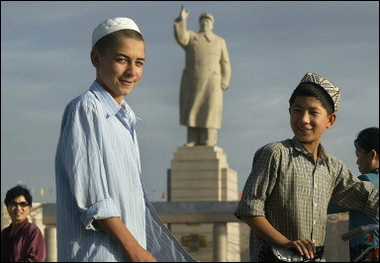
Since July 2009, there have been ethnic riots and tension in China's Xianjiang region between the ethnic Uighurs and the overall Chinese majority group, the Han.

Who are the Uighurs? The BBC explains the long history of tension in a recent Q&A article (pasted below).


Who are the Uighurs?

 
The Uighurs are Muslims. Their language is related to Turkish and they regard themselves as culturally and ethnically close to Central Asian nations.

China maintains a high military presence in the Xinjiang region.

The region's economy has for centuries revolved around agriculture and trade, with towns such as Kashgar thriving as hubs along the famous Silk Road.

In the early part of the 20th Century, the Uighurs briefly declared independence. The region was brought under the complete control of communist China in 1949. Officially Xinjiang is now described by China as an autonomous region, like Tibet to its south.


What are China's concerns about the Uighurs?


Beijing says Uighur militants have been waging a violent campaign for an independent state by plotting bombings, sabotage and civic unrest.
Since the 9/11 attacks in the US, China has increasingly portrayed its Uighur separatists as auxiliaries of al-Qaeda.
It has accused them of receiving training and indoctrination from Islamist militants in neighbouring Afghanistan, although little public evidence has been produced in support of these claims.
More than 20 Uighurs were captured by the US military after its invasion of Afghanistan. Although they were imprisoned at Guantanamo Bay for six years, they were not charged with any offence and many have now been accepted for resettlement elsewhere.


What complaints have been made against the Chinese in Xinjiang?


Activists say the Uighurs' religious, commercial and cultural activities have been gradually curtailed by the Chinese state.


China is accused of intensifying its crackdown on the Uighurs after street protests in the 1990s - and again in the run-up to the Beijing Olympics.


Over the past decade, many prominent Uighurs have been imprisoned or have sought asylum abroad after being accused of terrorism.

China is said to have exaggerated the threat from Uighur separatists in order to justify repression in the region.

Beijing has also been accused of seeking to dilute Uighur influence by arranging the mass immigration of Han Chinese, the country's majority ethnic group, to Xinjiang.

The percentage of Han Chinese in the region has gradually been rising. Han currently account for roughly 40% of Xinjiang's population, while about 45% are Uighurs.


What is the current situation in Xinjiang?


Over the past decade, major development projects have brought prosperity to Xinjiang's big cities.

The activities of local and foreign journalists are closely monitored by the Chinese state and there are few independent sources of news from the region.

China has been keen to highlight improvements made to the region's economy while Uighurs interviewed by the press have avoided criticising Beijing.

However occasional attacks on Chinese targets suggest Uighur separatism remains a potent - and potentially violent - force.


Why did the July violence happen?


At least 150 people died in ethnic violence in July 2009 - and while officials say most of the dead were Han Chinese, Uighur groups deny this.

One of the sparks for the violence seems to have been the deaths of two Uighurs in clashes with Han Chinese at a factory in southern China in June.

On 5 July, Uighurs came out onto the streets of Urumqi to protest about these killings - but how and why these protests turned violent remains a contentious issue.

The authorities blame Xinjiang separatists based outside China for the unrest, and they have singled out exiled Uighur leader Rebiya Kadeer.

"Rebiya had phone conversations with people in China on 5 July in order to incite," Xinjiang Governor Nur Bekri said in a televised address.

But Rebiya Kadeer told the BBC she was not responsible for any of the violence.

"Last time during the Tibet riots, [the Chinese government] blamed the Dalai Lama, and now with the Xinjiang riot, they are blaming me," she said.

Uighur exiles say police fired indiscriminately on peaceful protests - adding that this was what led to the violence and deaths.


Source:
"Q&A: China and the Uighurs." BBC NEWS | News Front Page | Asia-Pacific. British Broadcasting Corporation, 8 July 2009. Web. 31 Jan. 2010. http://news.bbc.co.uk/2/hi/asia-pacific/7540636.stm.

Photo Source

Saturday, January 30, 2010

Uighurs returned to China 'disappear' says rights group


The Human Rights Watch (HRW) has spoken out about the apparent "disappearance" of twenty ethnic Uighurs in a BBC News article from last Friday, January 29. After the riots last July in northern China, which left 97 dead, many Uighurs fled as refugees to Cambodia. However, in December, twenty were forcibly returned to China -- and now have disappeared into a "black hole." It is important to note that the majority of those killed in the riots were of the majority Han group and the Han population of Urumqi, the provincial capital, demanded retribution. Sophie Richardson of HRW says that the Chinese government must disclose the location and status of the group and "treat all returnees humanely, ensure fair trials, and not persecute individuals for activities and speech that are protected under international law." Although China's Foreign Ministry has not issued a comment, Bejjing has referred to those who fled to Cambodia as criminals.


This sad development in the deeply embedded ethnic conflict between the majority Han and the minority Uighurs is evidence of the lack of human rights in China. Despite opposition from the United Nations and the United States, the Chinese government forced the group to return from Cambodia, where they had seeked asylum. The lack of transparency in the Chinese government is also demonstrated, as even the relatives of the captured do not know their wherabouts. Because many Uighurs have suffered harsh treatment and torture when returning from other countries, it is virtually guranteed that the group in question will face prosecution with the possibility of death. As in Tibet, the Chinses government has tried to dilute the indigenous culture by moving millions of Han into the region. Currently, Han account for 40% of Xianjiang's population and about 45% are Uighurs. China sees the growing presence of the Han as a way to quell ethnic tensions by way of sheer dominance, but tensions between the mainly Muslim Uighurs and the atheistic Chinese government have been simmering for years. The tensions are founded by several deep cleavages: regional, religious, ethnic and even cultural; thus, the Uighurs want more autonomy than is allowed by Bejjing.
 
 
Source: "Uighurs returned to China 'disappear' says rights group." BBC NEWS | News Front Page | Asia-Pacific. British Broadcasting Corporation, 29 Jan. 2010. Web. 31 Jan. 2010. http://news.bbc.co.uk/2/hi/asia-pacific/8487724.stm.
 
Photo Source
 
Grade this post.