Pages

Showing posts with label China. Show all posts

Sunday, May 9, 2010

AIDS Activist Leaves China After Government Pressure

“When I work in China, they can really find a target to attack. When I left, they no longer had a target.”

Wan Yanhai (CIES)

Edward Wong of the New York Times reports that, Wan Yanhai has left China for the U.S. with his family in order to better continue his work as an AIDS activist. Wan is the founder of a prominent AIDS activist group, the Aizhixing Institute (Bejjing), which had been the subject of increasing governmental pressure. Kate Krauss, Wan's friend and director of the AIDS Policy Project, said that it became "impossible for Wan Yanhai to remain in China" because of the government. The governmental pressures include scrutiny from the tax agencies. The tax officials were not local, but rather unusually, from a municipical authority. Wan's office was even investigated by the fire department, apparently to ensure the office was in line with fire safety codes. It is important to note that Wan is extremely notable in AIDS campaigning in China, and has, in fact, dealt with the government before. Aizhixing was founded in 1994, a time when AIDS was not spoken about much publicly. In 2002, Wan was detained for four weeks because of pointing his finger in the mid-'90s to the government’s negligence the cause of an HIV spread in Henan Province villages.

The inquiries on Wan are not isolated; they come at a time of increased inspection on all civil society groups -- particularly those that receive foreign investment. The vitality of grassroots organizations in an important indicator of the health of citizen-state relations. The fact that Wan had to relocate to Philadelphia in order to continue his activism is not a promising sign for the global legitimacy of the Chinese government. Also, in the last year, administrative pressure has been a method of pressure on civil society groups. For example, in July 2009, Gongmeng, a legal research organization in Beijing, was shut down and a leader detained after an investigation by tax officials.

Saturday, March 20, 2010

Official in China Says Western-Style Democracy Won’t Take Root There

Li Fei, deputy director of the legislative affairs commission of the standing committee of the National People’s Congress, stressed already high tensions between China and Western nations like the U.S. in a recent interview. As Edward Wong of the New York Times writes in a Saturday article, Mr. Li's statements come in spite of recent statements by other officials saying "in public and in the Chinese news media that the country is moving toward democracy, implying that some form of a Western-style political system could take root." However, sometimes officials say directly that China will not have a Western-style democracy. Mr. Li said that "different countries have different election rules and a socialist China won’t follow Western election campaigns." He also said that a country's wealth is a prerequisite for Western-democracy: “Western-style elections, however, are a game for the rich,” he said. “They are affected by the resources and funding that a candidate can utilize. Those who manage to win elections are easily in the shoes of their parties or sponsors and become spokespersons for the minority.” 


National People’s Congress
These sentiments betray a disregard for the voice of the population being expressed through direct elections, undermining citizen-state relations in the Comparative Government viewpoint. Mr. Li said that the priority should be on improving the current style of elections, not expanding the use of direct election. Yet, the current system of elections in China is nothing more than a nominal process. Many critics of China from the West say that people at the local level are given no choice but the Communist Party. I thought it was very interesting that Mr. Li made such blunt comments; however it is not the first time as Wu Bangguo, chairman of the standing committee of the National People’s Congress, said in March 2009 that China would never "copy" Western countries and have a multiparty democracy. 


Li Fei's interview was originally published online by China Daily. Read it here.


Article Source
Photo Source


Grade This Post - Extra Credit

Sunday, March 7, 2010

Rare Outspoken Reform Call From China State Media

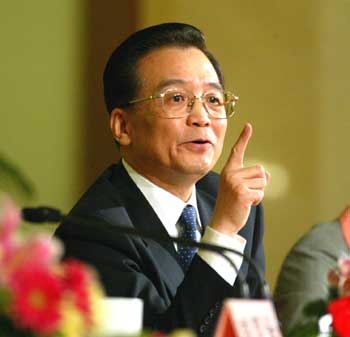
Premier Wen Jiabao

It might seem that 'freedom of speech' is a basic right alloted by the government to its people. However, this is clearly not the case in China. As reported by the Associated Press in the New York Times, thirteen different newspapers pulished a joint editorial criticizing the hukou policy. The hukou policy dates back to ancient China and is now required by law in China and Taiwan. Houkou refers to the residency system that is managed by household registration. Mao's purpose in implementing this policy was to control migration between cities and rural areas. Yet in recent years, with increasing urbanization in China, the system's limits have begun to be pushed. It is extremely hard to change one's status from rural to urban, meaning that migrant workers in the cities miss out on government services. Furthermore, the problem continues into the next generation, as children born in the cities to migrant parents are registered as 'rural' citizens, preventing such children from access to education. The editorial, signed with the logos of thirteen newspapers, was published on Monday; by Tuesday, the orginals and the links had been removed. On the past Saturday, Premier Wen Jiabao noted the tensions stemming from hukou and promised reform. The timing of these events is particularily significant since the National People's Congress, China's biggest event, began on March 12th.

''Freedom of movement is a human right."
                            -- Removed Editorial
Here, regional cleavages are displayed as are issues with citizen-state relations. By hindering access to government services from a certain group of citizens, the Chinese government is diminishing their own legitimacy and distancing themselves from their own people. The now removed editorial praised Wen Jiabao for acknowledging the problem and promising to take action which indicates a faith in the governement. Nevertheless, disregarding recent investments in interior China, there is a very distinct regional cleavage between the rural interior and urbanized coastal area. The Hukou policy enforces this cleavage and by doing so hinders national unity. The apparent lack of freedom of speech, which as mentioned earlier is a basic right of democracy and is seen as vital in many Western states, will do nothing for China in the international realm. However, the strong words of the editorial are being repeated across the globe which may have a positive effect on the abolishment of hukou.


Grade This Post.

Sunday, February 21, 2010

China Intensifies Tug of War With India on Nepal


Chinese Premier Wen Jiabao (L, front) and Nepali Prime Minister Madhav Kumar Nepal (R, front)


Jim Yardley wrote last week in the New York Times about the shifting foreign relations power structure in Nepal. The article discusses China's growing importance in the world and in South Asia, a region traditionally dominated by India. Nepal is situated between China and India, the two most populous countries in the world. The Himalayas have always been a solid physical barrier between China and Nepal, while the many cultural and economic ties to India have created a historical connection between India and Nepal. However, with the growing presence of China in the global sphere, it is very important for small nations like Nepal to keep good relations with the Chinese government. From the other side, Nepal appeared on China's radar during Tibetan protests erupted in March 2008, just months before the Beijing Olympic Games. While the Chinese government was able to block the international media from the protests in Tibet itself, the Nepali protests attracted much international attention. Ashok Gurung, director of the India China Institute at The New School, says that "the Chinese realized that Nepal is going to be an important site where they could potentially be embarrassed on Tibetan issues." Nepal is an important place in Tibetan issues because it has historically been a tacit transit for Tibetans to cross over to India for pilgrimages or higher education. For India's part, the country is not worried about economic competition so much as the threat of “political agitation on the Nepalese side of their shared border, as well as the possibility that terrorists trained in Pakistan could transit through Nepal."


This is an important illustration of China's growing strength in the world. Not only has China been strengthening ties with Nepal, with which it has the Tibet issue, it has been rapidly signing agreements with even the tiniest of South Asian countries like the Maldives. This signifies China's growing awareness of the importance of preemptively beneficial international treaties. Furthermore, the China-Nepal situation is evidence of China's continued antagonism of their Tibetan population. Tenzin Taklha, the secretary for the Dalai Lama, says that the China-Nepal agreements -- which include the stationing of Nepali armed police officers in isolated regions like Mustang and Manang on the border with Tibet and more security and vigilance on both sides of the border -- makes things "more difficult for Tibetans."


Grade This Post


Photo Source: Xinhua/Li Tao via

Sunday, February 7, 2010

Control of China's Financial System


In a recent Economist article titled: Red mist: Who matters in the world's second-largest financial system is barely understood, the author explains some of the inner workings of China's financial institutions, and how the government controls them.

Not only is the functioning of the Chinese banks mysterious, but most people will not even discuss it in any way that may be recorded--only face to face. China has various secrecy laws that may be violated if bank functions are discussed.

All credit is controlled by the government. The banks collect it, and must pay taxes on it, but its existence is dictated by the government. Recently, lending has been tightened up, and "favored industrial companies have been getting urgent calls from their bankers demanding that they immediately scoop up their credit needs for months to come, or be subject to a freeze of uncertain duration." Some loans, such as those over $500 million are thought to be entirely controlled by the state, and the banks are simply used for the transactions.

While most banks are not directly run by the government, regulators attend major meetings and carry the title of "head of discipline." One exception to this rule is China Development Bank, "run by a powerful government official, Chen Yuan" The government can also move executives from one bank to another at its will. sometimes they will even move the executive of one bank to its main competitor, which happened with Shang Jiangou in 2006. Some believe this move had to do with Guo Shuqing, China Construction Bank's chairman, being rumored to be running for a political position.

Many times, the banks with executives who do not move around have more power, and even bid on acquisitions outside of China. Sometimes this is stopped, and suspected to be blocked by the government, such as when ICBC dripped out of bidding for Hong Kong's Wing Lung Bank in 2008.While some financial institutions have autonomy, others see their link to the state as a useful asset.

All important decision are technically made by government officials, even those that would be considered private matters in any country other than China.

This system creates difficulty in the worlds economy. All of China's economic decisions are based on what the government wants, which means foreign and domestic policy. All of the major decisions are made in a way which benefits China. "During the depths of the financial crisis, when money was being sought for Morgan Stanley from CIC, Hank Paulson, then America’s treasury secretary, called Mr Wang [the vice-premier responsible for the financial sector] for his blessing." This type of international political and economic clout put China in a position to control increasing amounts of the world.

Sunday, January 24, 2010

The Current Status of Capitalism in China


About thirty years ago, China created the special economic zone of Shenzhen.
It is near Hong Kong and is one of the few places in China where the
government has not restricted business.


When Shenzhen was created, it flourished with new businesses because
entrepreneurs only had to comply with a few laws. They were allowed to
compete freely, and were not controlled in any way by China’s government.
This true capitalism created a massive city of millions of people willing to
work for very little money, which has caused a number of foreign businesses
to set up factories in the area because the costs of production are so much
lower than any other place.
Unfortunately, the economic prosperity is no longer bringing
in entrepreneurs at the rate it once was. A recent study has shower that over
the last five years, the population creating new businesses has dropped seven
percent. This trend is not only seen in Shenzhen, but in many other cities, at
least five other cities appear to be following the same trend.

This trend is correlated to two main factors. Shenzhen is running out of
land, and China’s businesses are taking some of the employees that once got
the best pay within the special economic zone. To find out more, read
The Economist’s article: The Spirit of Enterprise Fades.

These facts mean that there is an increasing amount of competition from
both inside China, and from global markets. This competition will not only
cause businesses within the special economic zone to lose employees to
areas within China, but they will also be forced to compete on a global market
that they are not used to because of their lack of investors.

The playing field will soon be leveled with these economic changes. This
could dramatically change the foreign and economic policy of many countries
when they find that their largest companies may be moving their production to
new locations around the globe.


Grade This Post.

Saturday, January 23, 2010

Single-Party Democracy


In a recent New York Times article, Roger Cohen compares the economic effect of the differing family structures of China and the U.S. Cohen points out that the one-child policy makes children special in the family structure and thus the attention and investment in children is far greater than in the U.S. The article lauds China’s fast growth and says that it won’t stop anytime soon. While the negatives of China’s growth structure such as current housing bubbles are acknowledged, the article as a whole boosts China’s political decisions for their promptness. Intrestingly, this article comes at a time when there is rising resentment for the ineffectuality of the government in the face of the economic recession in America. Cohen says that the seemingly oxymoronic term “single-party democracy” has the potential to be the “most important political idea of the 21st century.” Although the Chinese government is extremely controlling, recent assortments in the form of nongovernmental organizations that work with the Chinese government.

The article touches on the comparative degress of perceived political effectuality and the economic progress in terms of family (social demographic effefct). Because China's government is centralized and does depend on the people's vote in daily matters, China, in the wake of a disaster, can act quickly instead of the slow political beaucracy of the American political scene; this leads to a trust that the government can acomplish change, although a faith that the government is neccesarily doing the right thing is not guranteed (this manifests itself in China's dismal human rights record). It is extremely important to note that this article is in fact an op-ed, meaning that Cohen's opinion permeates each paragraph as opposed to a simply, objective stating of the facts. It is clear throughout the article that Cohen is impressed with China; he glazes over any negative aspects of China's growth. He cites the stable family culture -- usually in the nuclear family form with Confucian values of filial duty -- as the grounding force which allows for rapid growth and acts as a "moral compass" in the face of modernity.


Grade this post.

Cohen, Roger. "Single-Party Democracy." The New York Times. The New York Times Company, 21 Jan. 2010. Web. 22 Jan. 2010.