
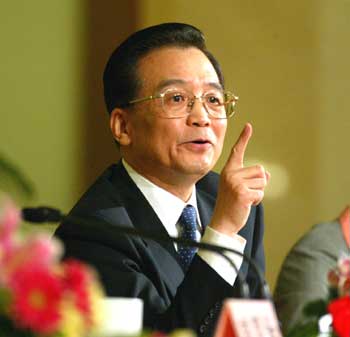
Premier Wen Jiabao
It might seem that 'freedom of speech' is a basic right alloted by the government to its people. However, this is clearly not the case in China. As reported by the Associated Press in the New York Times, thirteen different newspapers pulished a joint editorial criticizing the hukou policy. The hukou policy dates back to ancient China and is now required by law in China and Taiwan. Houkou refers to the residency system that is managed by household registration. Mao's purpose in implementing this policy was to control migration between cities and rural areas. Yet in recent years, with increasing urbanization in China, the system's limits have begun to be pushed. It is extremely hard to change one's status from rural to urban, meaning that migrant workers in the cities miss out on government services. Furthermore, the problem continues into the next generation, as children born in the cities to migrant parents are registered as 'rural' citizens, preventing such children from access to education. The editorial, signed with the logos of thirteen newspapers, was published on Monday; by Tuesday, the orginals and the links had been removed. On the past Saturday, Premier Wen Jiabao noted the tensions stemming from hukou and promised reform. The timing of these events is particularily significant since the National People's Congress, China's biggest event, began on March 12th.
''Freedom of movement is a human right."
-- Removed Editorial
Here, regional cleavages are displayed as are issues with citizen-state relations. By hindering access to government services from a certain group of citizens, the Chinese government is diminishing their own legitimacy and distancing themselves from their own people. The now removed editorial praised Wen Jiabao for acknowledging the problem and promising to take action which indicates a faith in the governement. Nevertheless, disregarding recent investments in interior China, there is a very distinct regional cleavage between the rural interior and urbanized coastal area. The Hukou policy enforces this cleavage and by doing so hinders national unity. The apparent lack of freedom of speech, which as mentioned earlier is a basic right of democracy and is seen as vital in many Western states, will do nothing for China in the international realm. However, the strong words of the editorial are being repeated across the globe which may have a positive effect on the abolishment of hukou.
Grade This Post.



 Posts
Posts


