Pages

Showing posts with label Wen Jiabao. Show all posts

Sunday, March 7, 2010

Rare Outspoken Reform Call From China State Media

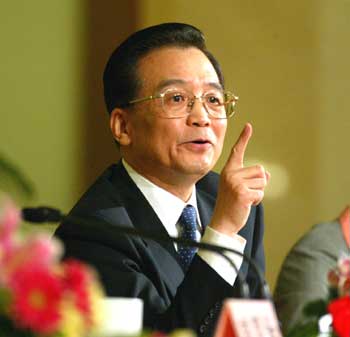
Premier Wen Jiabao

It might seem that 'freedom of speech' is a basic right alloted by the government to its people. However, this is clearly not the case in China. As reported by the Associated Press in the New York Times, thirteen different newspapers pulished a joint editorial criticizing the hukou policy. The hukou policy dates back to ancient China and is now required by law in China and Taiwan. Houkou refers to the residency system that is managed by household registration. Mao's purpose in implementing this policy was to control migration between cities and rural areas. Yet in recent years, with increasing urbanization in China, the system's limits have begun to be pushed. It is extremely hard to change one's status from rural to urban, meaning that migrant workers in the cities miss out on government services. Furthermore, the problem continues into the next generation, as children born in the cities to migrant parents are registered as 'rural' citizens, preventing such children from access to education. The editorial, signed with the logos of thirteen newspapers, was published on Monday; by Tuesday, the orginals and the links had been removed. On the past Saturday, Premier Wen Jiabao noted the tensions stemming from hukou and promised reform. The timing of these events is particularily significant since the National People's Congress, China's biggest event, began on March 12th.

''Freedom of movement is a human right."
                            -- Removed Editorial
Here, regional cleavages are displayed as are issues with citizen-state relations. By hindering access to government services from a certain group of citizens, the Chinese government is diminishing their own legitimacy and distancing themselves from their own people. The now removed editorial praised Wen Jiabao for acknowledging the problem and promising to take action which indicates a faith in the governement. Nevertheless, disregarding recent investments in interior China, there is a very distinct regional cleavage between the rural interior and urbanized coastal area. The Hukou policy enforces this cleavage and by doing so hinders national unity. The apparent lack of freedom of speech, which as mentioned earlier is a basic right of democracy and is seen as vital in many Western states, will do nothing for China in the international realm. However, the strong words of the editorial are being repeated across the globe which may have a positive effect on the abolishment of hukou.


Grade This Post.

Saturday, March 6, 2010

Wen announces staggering decrease in military budget growth rate


According to a March 5 article from from The Economist, Chinese Prime Minister Wen Jiabao announced at the first day of the annual National People's Congress a mere 7.5% increase in military spending, down from 17.8% last year. Amid tensions due to recent arms sales to Taiwan by American manufacturers, this figure was quite unexpected, as most analysts were expecting an increase well above 10%. In fact, the Chinese government has not offered such a low increase in the military budget in the past 20 years. The rest of the world is left to ponder this sudden double take in the Chinese military budget: perhaps the government expects difficult times, despite China's relative success in the recession, perhaps the government sincerely is attempting to ameliorate its menacing image as a military threat. Pentagon analysts assert that China's military accounts have traditionally shortchanged the number of yuan spent on the military budget. For example, last year China declared a budget of $60 billion, while American estimates range from $105 to $150 billion. However, this year's shockingly low increase should not be cast aside. China could have easily declared a increase of as high as 20%, further reinforcing strained relations with neighboring countries such as Taiwan. The new figure also demonstrates a new air of caution that Beijing has taken in response to tell-tale signs of a possible housing crisis and the wearing off of stimulus cash. Either way, the reduced military estimate bodes well for foreign powers looking for a friendlier relationship with China.

This shift in economic measures demonstrates China's increasing insecurity about its future economic performance. Although China boasts a economic growth rate of 8+%, as Prime Minister Wen was only too quick to point out in his two hour speech, this withdrawal in military spending indicates that Chinese leaders are taking greater measures to preserve this economic prosperity by cutting down in the annual military fiscal increase. The lower rate of increase also shines a light on China's efforts to improve international relations. International figures have obviously had some effect on China's image, and Chinese leaders are clearly willing to work on their common perception as a major military threat. The question of legitimacy also arises when discussing whether these figures will be upheld, as in the past China's military estimates are much lower than their actual value. The Economist calls the Chinese budgets "opaque," emphasizing the lack of transparency when declaring military spending, calling the authenticity of the figures cited by the National People's Congress into question.


Photo source: Remko Tanis, http://www.flickr.com/photos/remkotanis/4408321612/


Grade This Post