
While "google" may be a common verb in the U.S., in China, it’s not a necessary part of the 21st Century lingo. Even though Google moved its East Asian headquarters to Hong Kong recently, effectively pulling the search engine out of Chinese control, many Chinese citizens don’t feel that they will miss it. As reported by Jonathan Stray and Lily Lee in the New York Times today, there are other options that are equally, if not more, popular. “I heard that Google is leaving China. But I don’t care. Why should I? I’m fine with Baidu,” said Xiong Huan, a 27- year-old engineer. Luo Peng, a Beijing salesman said that “Just like YouTube and Facebook, my life is fine without them. I can always use other similar services that are available.” However, the real political story is in the brief, but potent rise in search figures for politically sensitive terms the day that Google announced its shift. Tuesday, March 23rd was when Google began to offer uncensored Chinese-language search results. Interestingly, searches for “Tiannmen,” “Falun Gong,” and “corruption” increased by more than ten times on the same day. Yet the searches on the Hong Kong-based engine dropped soon, in part because even if search results do come up on controversial subjects, the sites themselves are still blocked.
The implications of this are important in citizen-state relations, foreign investments, and freedom of press. It is interesting that the citizens seem not to care as much; perhaps because they do have Baidu, which is always running unlike Google, albeit always censored. However, a clear thirst for censored information is evident through the searches. While Google is the dominant search engine in the Western world, China’s hacking and censorship is not attractive to foreign investors, particularly those that deal with sensitive information. Finally, freedom of press which is held paramount in Western-style democracy, is a definite hindering factor in China’s modernization.
Showing posts with label freedom. Show all posts
Showing posts with label freedom. Show all posts
Sunday, March 28, 2010


Sunday, March 7, 2010
Rare Outspoken Reform Call From China State Media
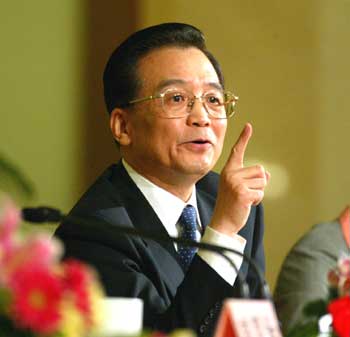
Premier Wen Jiabao
It might seem that 'freedom of speech' is a basic right alloted by the government to its people. However, this is clearly not the case in China. As reported by the Associated Press in the New York Times, thirteen different newspapers pulished a joint editorial criticizing the hukou policy. The hukou policy dates back to ancient China and is now required by law in China and Taiwan. Houkou refers to the residency system that is managed by household registration. Mao's purpose in implementing this policy was to control migration between cities and rural areas. Yet in recent years, with increasing urbanization in China, the system's limits have begun to be pushed. It is extremely hard to change one's status from rural to urban, meaning that migrant workers in the cities miss out on government services. Furthermore, the problem continues into the next generation, as children born in the cities to migrant parents are registered as 'rural' citizens, preventing such children from access to education. The editorial, signed with the logos of thirteen newspapers, was published on Monday; by Tuesday, the orginals and the links had been removed. On the past Saturday, Premier Wen Jiabao noted the tensions stemming from hukou and promised reform. The timing of these events is particularily significant since the National People's Congress, China's biggest event, began on March 12th.
''Freedom of movement is a human right."
-- Removed Editorial
Here, regional cleavages are displayed as are issues with citizen-state relations. By hindering access to government services from a certain group of citizens, the Chinese government is diminishing their own legitimacy and distancing themselves from their own people. The now removed editorial praised Wen Jiabao for acknowledging the problem and promising to take action which indicates a faith in the governement. Nevertheless, disregarding recent investments in interior China, there is a very distinct regional cleavage between the rural interior and urbanized coastal area. The Hukou policy enforces this cleavage and by doing so hinders national unity. The apparent lack of freedom of speech, which as mentioned earlier is a basic right of democracy and is seen as vital in many Western states, will do nothing for China in the international realm. However, the strong words of the editorial are being repeated across the globe which may have a positive effect on the abolishment of hukou.
Grade This Post.
Subscribe to:
Posts (Atom)

 Posts
Posts


